
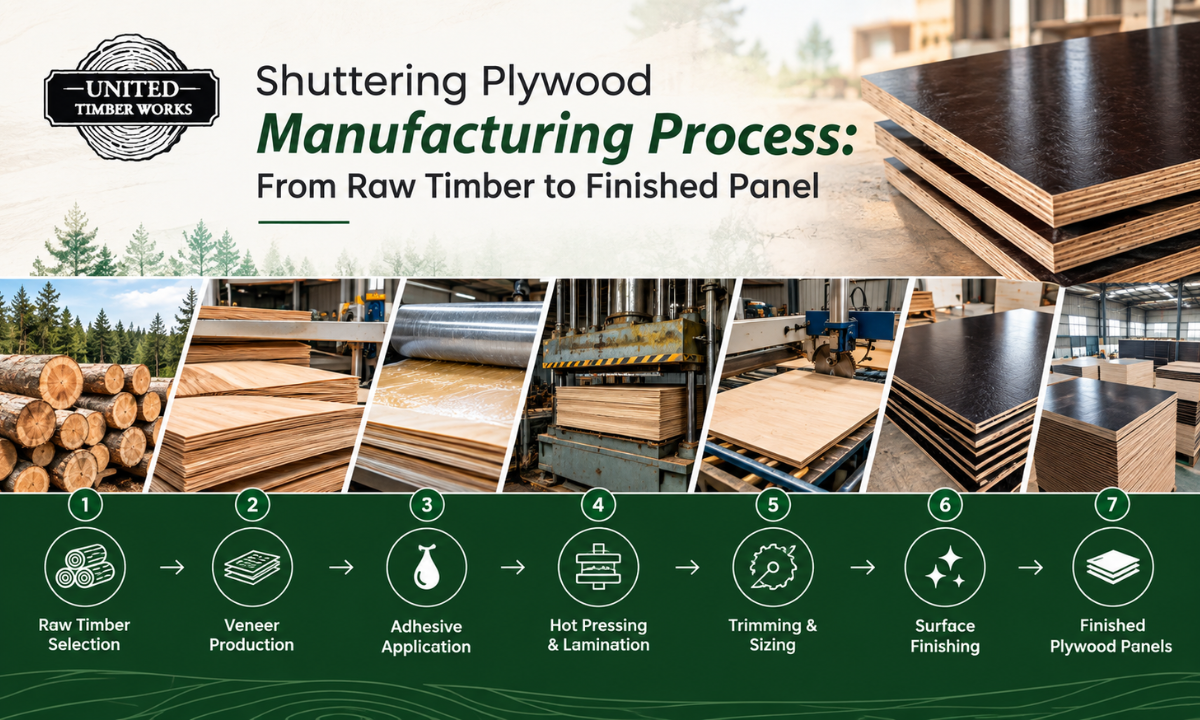
Every concrete pour tests the plywood underneath it. The pressure, the moisture, the repeated stripping and the reuse come down to how the sheet was actually made. At United Timber Works, this is exactly why the manufacturing process gets as much attention as the finished product itself. When you understand what happens between raw timber and a finished panel, it becomes much easier to judge which shuttering plywood is actually built for your site and which one is only built for the catalogue. This blog walks through the shuttering plywood manufacturing process step by step. So you know precisely what separates a sheet that survives ten pours from one that fails on the third.
Why the Manufacturing Process Decides How Your Formwork Performs
Shuttering plywood does a very different job than plywood used for furniture or interiors. It has to hold wet concrete under pressure, release cleanly without damaging the surface finish, and go back onto the next pour without warping or delaminating. None of this happens by accident. It is the result of how the timber is chosen, how the veneers are bonded, and how the panel is pressed and finished. For a contractor or site engineer, this matters directly. A panel that fails early means:
- Higher rejection rates on site
- More frequent replacement orders
- Delays in the pour schedule
- Inconsistent concrete finish across slabs
Understanding the process helps you ask the right questions before you place an order, not after a shipment has already let you down.
Step-by-Step of Shuttering Plywood Manufacturing Process
These are the steps that follow:
Stage 1: Timber Selection and Log Preparation
You can’t build a good sheet on bad timber, so everything starts with picking the right species. Manufacturers who take shuttering seriously reach for Eucalyptus hardwood, and there’s a reason for that beyond tradition: hardwood veneers simply take a beating better than softer woods when a panel spends its whole working life under concrete pours. It doesn’t buckle as easily, and it holds up through moisture cycle after moisture cycle on site.
At this stage, logs are inspected for straightness, density, and consistency before they move into production. Any log with visible defects gets filtered out early, because a weak core layer becomes a weak panel no matter how well the outer layers are finished later.
Stage 2: Veneer Peeling and Sorting
Once a log clears selection, it heads into peeling, where it’s shaved down into thin veneer sheets. Think of these as the raw material for every layer that follows, since they eventually stack up to form the panel’s core and face.
Peeling is only half the job, though. Each sheet then gets sorted for thickness and surface quality, because even a slightly thicker or thinner layer in the wrong spot can leave a weak point once the panel is pressed. Anything with an uneven patch or a visible flaw gets pulled aside right there, well before it ever has a chance to end up in a finished board.
Stage 3: Drying and Moisture Control
Freshly peeled veneer carries a high moisture content, and if it goes into bonding at this stage, the finished panel will not hold its shape. Every veneer sheet is dried to bring moisture levels down to a controlled range before assembly. This step directly affects two things contractors care about on site:
- Dimensional stability, so panels don’t warp after delivery
- Bond strength, since resin adheres far better to properly dried veneer than to damp sheets
Skipping or rushing this stage is one of the most common reasons lower-grade plywood delaminates after just a handful of pours.
Stage 4: Resin Bonding and Layer Assembly
This is where individual veneer sheets become a single, unified panel. Manufacturers with years of experience bonds its shuttering plywood veneers with phenolic resin, a bonding agent known for its strong resistance to water and moisture, which is exactly the kind of stress concrete formwork puts on a panel repeatedly.
Layers are cross-laminated, meaning the grain direction alternates from one veneer to the next. This is what gives the finished sheet its strength in both directions, rather than only along a single grain line, and it’s a core reason plywood outperforms solid timber for formwork applications.
Stage 5: Hot Pressing for Density and Strength
With the resin applied, the stacked veneers move into the press, where heat and pressure work together to cure that resin and lock the layers into one dense board. This is really the stage where the panel earns its keep on site. Get it right, and the sheet:
- Resists edge splitting under repeated concrete loads
- Maintains a flat, even surface after multiple pours
- Holds its bond lines even under sustained moisture exposure
Stage 6: Film Facing for a Reusable, Smooth Finish
After pressing, the panel is film faced. This film layer is what gives shuttering plywood its smooth, mirror-like surface and is central to why it strips cleanly off the concrete after each pour instead of sticking or tearing the surface finish.
Stage 7: Edge Sealing, Trimming and Quality Checks
The final stage brings the panel to its finished dimensions. Edges are trimmed and sealed to stop moisture from creeping into the core layers over repeated site use, since an unsealed edge is often where deterioration begins first, long before the face of the panel shows any wear.
What This Process Means for Your Next Order
When you’re comparing shuttering plywood suppliers, the manufacturing process is really what you’re evaluating, even if the conversation only touches on price and delivery timelines. A panel made from properly selected Eucalyptus hardwood, dried correctly, bonded with phenolic resin, and pressed to IS:4990 standards will simply behave differently on site than one that has cut corners at any single stage.
This is also where consistency at scale matters. United Timber Works has delivered around 14.47 crores sq ft of shuttering plywood to 87+ contractors and 169 dealers across India over the last five years, backed by an 8.5-acre integrated manufacturing setup and 47+ years of experience in plywood production. That scale only holds up if the process behind it stays disciplined on every single sheet, not just the ones that get tested.
Choose a Manufacturer Whose Process You Can Trust
The gap between plywood that performs and plywood that disappoints rarely shows up on the surface. It’s built in, stage by stage, long before the sheet ever reaches your site. Knowing how the shuttering plywood manufacturing process actually works gives you a much sharper way to evaluate who you’re buying from.
If you want formwork that strips clean, holds its finish, and comes from a process backed by decades of consistency, United Timber Works is built around exactly that standard. Reach out to our team to discuss your next project’s shuttering plywood requirement and get a quote suited to your site’s scale and timeline.