
Are you tired of working with suppliers that don’t specify the material and behave as if every piece of plywood is the same? In modern construction, it’s the job of construction professionals to choose the right materials for every project to ensure everything falls into the right place. One wrong decision made in a rush or without the right information can affect your project timeline, your budget, and your reputation on site.
But you have already taken the right first step by looking it up. This guide will walk you through everything you need to know about film faced shuttering plywood, what it is, how it works, how it is different from regular plywood, and what are the factors you should consider before purchasing. By the time you finish reading, you will have confidence and know how to buy it without second-guessing yourself.
What Is Film Faced Shuttering Plywood?
Shuttering film faced plywood is basically a specific type of construction-grade plywood that is built for one demanding job. This plywood is used for creating the mould that holds wet concrete in place while it sets.
The core is made from multiple layers of hardwood veneer. In India, Eucalyptus hardwood is used since it is dense, holds nails and screws well, and does not give up easily under load. These layers are bonded together with Boiling Waterproof (BWP) phenolic adhesive. It stays intact even when moisture is sitting against it for hours.
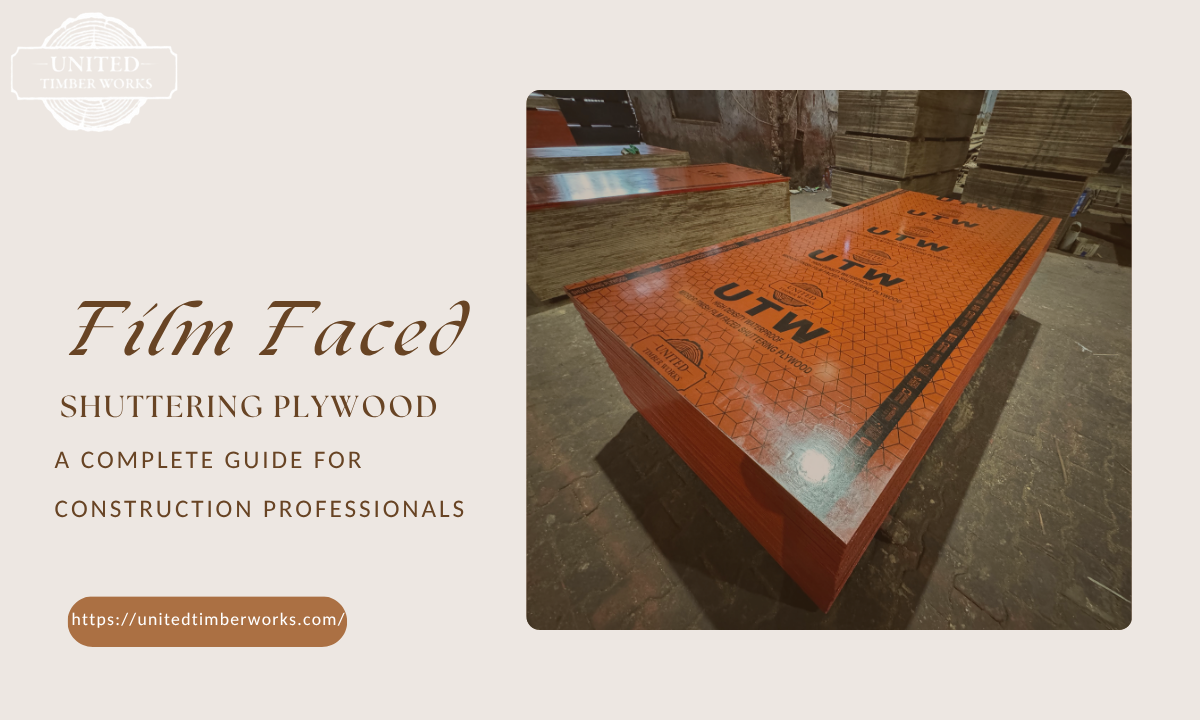
Both faces of this plywood are coated with a film. Generally, phenolic resin or melamine is used; this is heat-pressed directly into the panel surface. It is smooth, non-porous, and does not react to the moisture or alkalinity that wet concrete carries. That is what keeps the concrete from sticking and the board from breaking down, pour after pour.
This combination makes it absolutely different from regular plywood. The film face makes sure that the concrete does not stick to the board. The BWP adhesive keeps the layers from coming apart when wet concrete pushes against it while the concrete sets. And the hardwood core keeps the whole panel firm and does not allow it to bow or bend, even under heavy load. At United Timber Works, this is the procedure that is followed to manufacture film-faced shuttering plywood.
Why Can’t You Just Use Regular Plywood for Shuttering?
The best way to answer this query is to provide a side-by-side comparison that shows how regular plywood is different from construction-grade film faced sheathing plywood. These are the differences:
| Feature | Film Faced Shuttering Plywood | Regular Plywood |
| Adhesive grade | BWP (Boiling Waterproof / phenolic); it passes the 72-hour boiling water test | MR (Moisture Resistant / urea-based), it’s not suited for sustained wet contact |
| Surface coating | 120 GSM phenolic film on both faces | Unsanded or lightly sanded with no protective coating |
| Moisture resistance | High, which is tested and certified under IS:4990 | Low to medium, which is suited for dry or occasional moisture only |
| Reuse cycles | Significantly higher since the film coating protects the surface across multiple pours | Low because the surface degrades quickly under concrete contact |
| Finish on concrete | Smooth, mirror-quality finish | Rough requires additional patching and rework |
Where is Film Faced Shuttering Plywood Used?
Shuttering film faced plywood is the standard choice for every application where concrete is poured into a formed mould:
- Column and wall shuttering: This is where most contractors first use it. Every time, the film face strips off cleanly, and it leaves a smooth vertical surface that does not require any rework.
- Slab and deck formwork: In multi-storey buildings, the same panels get struck, moved, and reset floor after floor. A board that cannot handle that cycle becomes a liability fast.
- Foundation and footing work: There is very little room for error at the foundation level. If the board flexes under load, your footing dimensions are off, and that problem does not stay at the bottom and impact the entire project.
- High-rise construction: The panels go up with the building. This is what makes them worth it. If they stay consistent across every floor, pour after pour, without losing their shape or surface quality, your work will be easy.
- Infrastructure projects: Bridges, flyovers, culverts, tunnels, retaining walls; these sites are tough on materials. Standard plywood would not stand a chance. Film faced boards are built for exactly these conditions, and the only option you have
- Precast concrete production: In precast work, the concrete surface is the final product. If the board leaves a rough finish, there is no going back.
What to Verify Before Purchasing?
The market has a wide range of quality, and it is not always easy to spot them just by looking at a panel. Here is what to check before placing an order:
IS:4990 Certification
This is the Bureau of Indian Standards specification for concrete shuttering plywood in India. It covers bonding quality, moisture resistance, and face finish standards. Ask for the certification, and if the supplier cannot produce it, walk away.
Film Type and Weight
A heavier phenolic film gives more reuse cycles and better moisture resistance. Lighter melamine film is less expensive but wears faster. Know what you are buying and make the decision that will benefit you in the long run.
Core Species
Eucalyptus hardwood is one of the better core materials available in the market. It offers good density, nail and screw holding, and load distribution. Softwood cores are cheaper but perform less consistently.
Edge Sealing
Panel edges are the most vulnerable entry point for moisture. Sealed edges significantly extend the panel’s working life, particularly when boards are stored on site between pours.
BWP Adhesive Grade
Confirm the bonding adhesive conforms to IS:4990. If your supplier gives you vague answers on this matter, then there is no point in questioning further.
Supplier Reliability
The product quality matters, but so does the supplier’s ability to deliver on time, at volume, and with support if something goes wrong. A delayed material delivery on a floor cycle is going to be an expensive problem for you.
Don’t Let the Wrong Plywood Cost You the Project
Film faced shuttering plywood is the key element of construction work that shapes buildings. The wrong purchase will create delays, rework, and, most importantly, material waste that will directly impact the budget.
At United Timber Works, we offer IS:4990-certified plywood made from premium Eucalyptus hardwood cores. They’re designed to be reusable and resistant to moisture. Our plywood will provide a smooth, reliable surface finish that helps keep your concrete projects on track and within specifications. If you want to discuss your project requirements, check dealer availability in your region, or simply get a quote, visit our website.