
Every site has that corner where rejected shuttering panels go to die. Swollen edges, delaminated faces, sheets that gave up after three pours. Each one of those panels is money your project already spent and cannot recover. On large infrastructure work, where concrete cycles run back to back for months, that pile grows fast if the material is wrong. At United Timber Works, we have watched that shift happen from close range, supplying shuttering plywood to contractors and dealers across India since 1977. This blog explains, from that experience, why film faced shuttering plywood has become non-negotiable on serious infrastructure jobs.
What Sets Film Faced Shuttering Plywood Apart
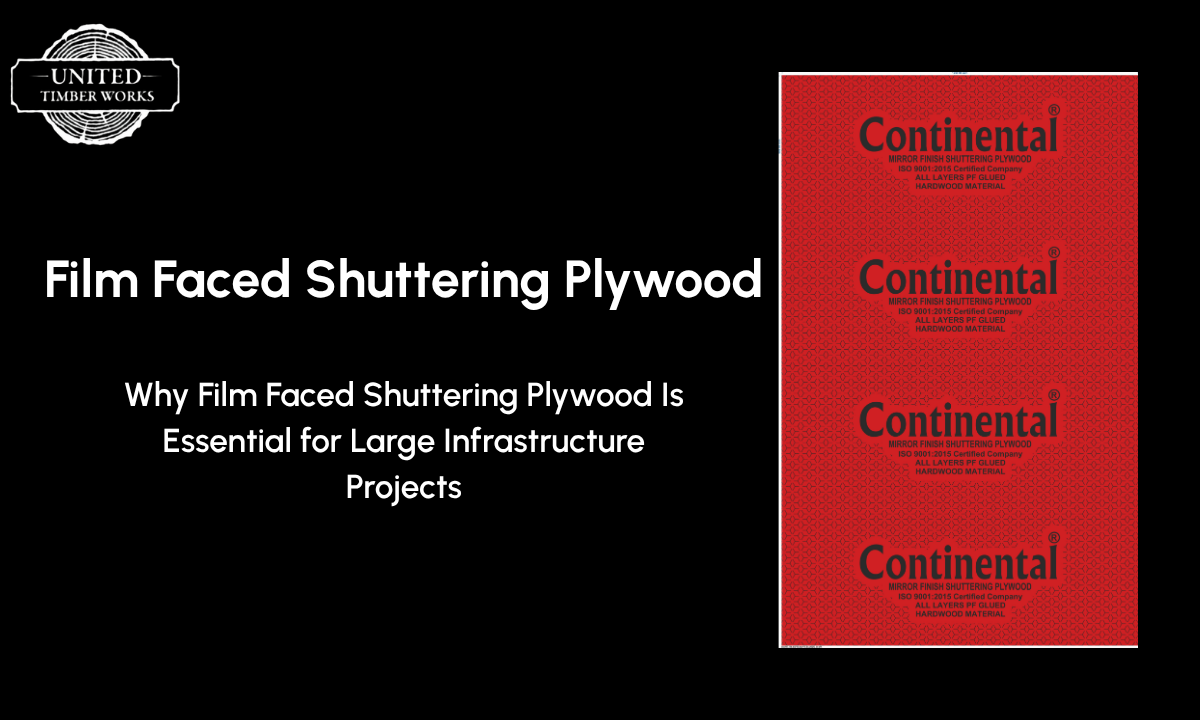
Film faced shuttering ply is a high-density, waterproof plywood with a phenolic film bonded to both faces. That film is the difference maker. It seals the surface against water and cement slurry, releases cleanly from cured concrete, and protects the panel through pour after pour. For a site engineer, this means three practical wins:
- More repetitions per sheet: The film takes the abuse instead of the face. You get pour after pour out of the same panel, while bare plywood is usually done after a handful.
- Cleaner de-shuttering: Concrete just does not stick to the film the way it clamps onto raw ply. Panels come off quicker, and you are not chipping away at the surface you just cast.
- A smoother finished face: The film is uniform, so the concrete comes out even. That is plaster and patch-up work you never have to order.
On a bungalow site, this is a bonus. On an infrastructure job with hundreds of columns and back-to-back slab cycles, it is the difference between a formwork budget that holds and one that does not.
Where It Proves Its Worth on Large Infrastructure Work
These are the reasons why you should choose film faced shuttering ply if you have a big project:
Repeated Pours Punish Weak Material
Infrastructure work is the same job done a hundred times. Pier, pile cap, wall, slab, strip, shift, cast again. The shuttering panel that survives one more cycle than expected is quietly saving you money. The one that dies early is quietly doing the opposite, because now someone has to stop and source replacements mid-schedule. Film faced shuttering plywood is made for this grind. The dense hardwood core matters more than most buyers realise; a mixed or hollow core simply gives up sooner, no matter how good the film looks on day one.
Water is Everywhere on the Site
Curing water, monsoon, and the wet concrete itself. Formwork on an Indian site can stay damp for weeks, and ordinary plywood handles that badly. It drinks the moisture, swells, starts letting go at the glue lines, and prints every one of those defects onto your concrete. A waterproof film faced panel sits through the same weeks and stays flat. This is really what IS:4990 exists for. It is the Indian standard for shuttering plywood, and if a vendor cannot show it, the conversation should end there.
Finish Quality is Money
Nobody budgets for bad concrete, but everyone pays for it. Every ridge and ripple in a cast surface turns into plaster, grinding, or a rework order weeks later. A mirror finish panel gives you concrete that mostly comes out right the first time. On one column, the savings look small, but across a full tower or a kilometre of viaduct, it stops being small.
Slab Cycles Cannot Wait for the Material
Casting schedules on large projects have no slack in them. Material that turns up late, warped, or ten sheets short does not just delay the pour; it pushes back every trade waiting behind it. Seasoned buyers know this, which is why they compare film faced shuttering plywood manufacturers in India on delivery record and responsiveness first, and argue about price per sheet later.
What to Check Before You Finalise a Shuttering Plywood Vendor
A quick checklist we recommend to every contractor and purchasing head:
- Certification: IS:4990 or walk away. There is no version of structural work where this is negotiable.
- Delivery record: Ask for their on-time delivery numbers, in writing if you can. “We always deliver on time” is not a number.
- Core timber: The film gets all the attention, but the core does the work. Ask what hardwood is inside. Premium Eucalyptus gives you the density and the screw-holding strength that repeated pours demand, and a vendor who gets vague about the core usually has a reason to.
- Manufacturing capability: Find out if they actually make the plywood or just move it. A manufacturer running its own integrated facility controls what goes into every batch. A trader reselling mixed stock is hoping you never check.
- After-sales response: Something will go wrong at some point. It does on every project. The real question is whether the supplier picks up the phone in thirty minutes or goes quiet for a week.
The One Question that Reveals Everything
“How many square feet have you delivered, and to whom?” A manufacturer with real infrastructure experience answers with figures and client names. One without it answers with adjectives.
Ready to Scale? Start with Plywood That Can Keep Up
Large infrastructure projects do not fail because of one big mistake. They bleed time and money through small, repeated ones, and unreliable shuttering material is one of the most common. Film faced shuttering plywood removes that weak link. It survives repetition, shrugs off water, speeds up de-shuttering, and delivers a finish your client will not argue with.
The next step is picking who makes it for you. If you want IS:4990 certified sheets, Eucalyptus hardwood cores, a manufacturer that has already delivered crores of square feet to working sites, and a support team that responds in minutes rather than days, talk to United Timber Works. Call us at +91 96714 89888, write to info@unitedtimberworks.com, or request a quote through unitedtimberworks.com. Your project deserves more than just products. It deserves commitment, and that is exactly what UTW brings to every dispatch.