
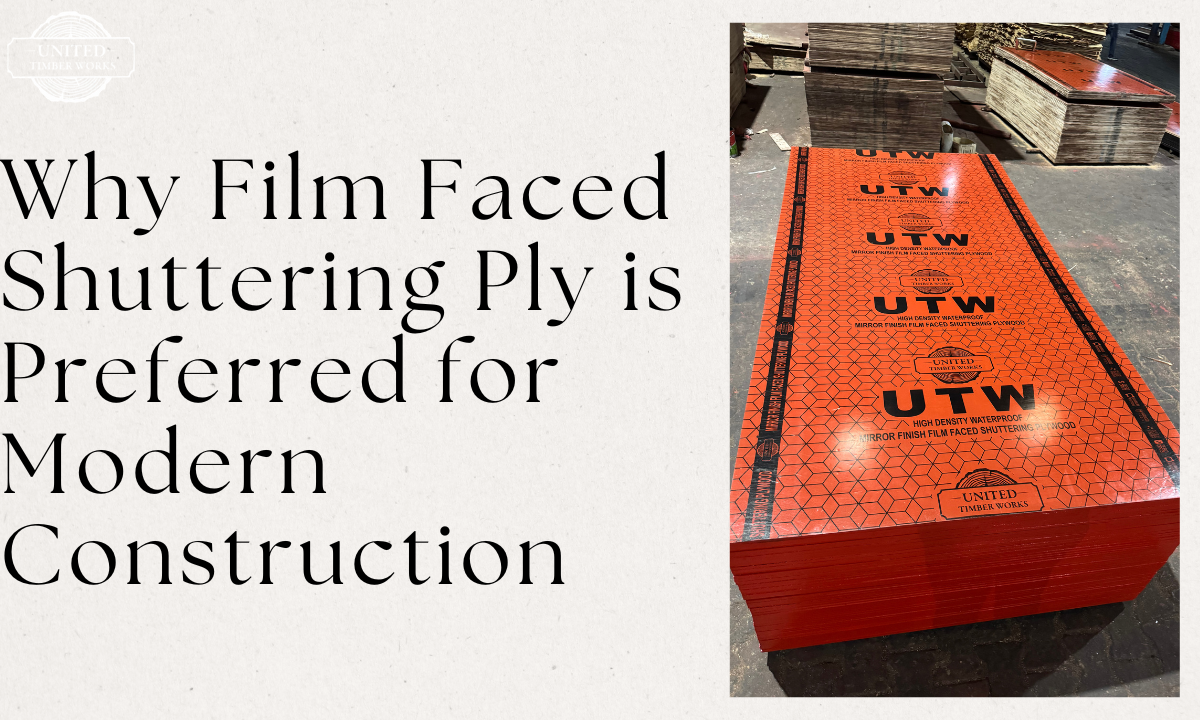
Walk across any serious construction site today, whether it is a high-rise or a flyover, and you will notice one thing about the formwork. Contractors who care about finish quality and cycle time have moved to film faced shuttering ply, and they rarely go back. The shift is not about following a trend. It is about hard site economics that offers fewer rejected pours, more repetitions per sheet, and a concrete surface that needs minimal finishing work afterwards.
At United Timber Works, we have watched this shift happen from the manufacturing side since 1977. Over the years of producing shuttering plywood from our facility in Yamuna Nagar, Haryana, we have seen why engineers, contractors, and developers keep specifying film-faced sheets for modern projects. Let’s find out why that happens in practical terms.
What is Film Faced Shuttering Ply?
Film-faced shuttering ply is a waterproof plywood used for concrete formwork, with both surfaces coated in a phenolic film. The film gives the sheet a smooth, non-porous face, so wet concrete does not bond to it, water does not soak into the core, and the panel releases cleanly after every pour. The core matters just as much as the film. High-density sheets built on hardwood hold their shape under the pressure of wet concrete. Sheets conforming to the Indian standard for concrete shuttering plywood are tested for exactly these conditions.
Why Modern Construction Sites Prefer Film-Faced Shuttering Ply
These are the reasons:
1. More Repetitions Mean Lower Cost Per Pour
Anyone who has watched ordinary shuttering material come off after the third or fourth pour knows how this story ends. The sheet drinks up moisture from the wet concrete, the edges swell, and the plies begin to peel apart. Then it goes to the scrap pile, and the site orders again. A good film faced sheet holds up over far more casting cycles, simply because the phenolic film and waterproof bonding stop moisture from reaching the core in the first place. Sit down with the numbers and work out the cost per pour rather than the cost per sheet, and the maths settles the argument on its own.
2. A mirror-smooth concrete finish
Strip the panels off a slab cast against film-faced ply, and the difference is right there in front of you. The concrete comes out with an even, closed face instead of the rough, grainy surface ordinary boards leave behind. For the site team, that saves real time and money:
- Much less plastering and patch-up work after de-shuttering
- Exposed columns, slabs, and retaining walls that look presentable the day the formwork comes off
- Fewer pours are getting flagged during quality checks
The right film faced shuttering plywood manufacturer will build the mirror finish range of plywood around this one idea. Get the panel face right, and the concrete largely takes care of itself.
3. Built for Indian site conditions
Spec sheets get written in air-conditioned offices. Formwork lives outdoors. Through the monsoon, panels on most Indian sites stay damp for weeks, soaked by rain one day and curing water the next, and dragged, stacked, and hammered in between. A waterproof film-faced sheet is made for exactly this treatment. The boiling water-resistant bonding that IS:4990 demands keeps the plies from blistering or separating through those wet and dry cycles, which is just a normal week on site here.
4. Faster shuttering and de-shuttering cycles
Concrete does not grip the film surface, so panels come away cleanly, without prying and without chipping the fresh edge. Carpenters wipe them down, re-oil them, and send the same sheets straight up to the next level. On one floor, that saves a few hours. Twenty floors in, it has quietly saved you weeks.
5. Dimensional stability under load
Wet concrete pushes against formwork harder than most people outside the trade realise. If a panel flexes between supports, you get bulging columns and wavy slab soffits, and someone pays to grind or fill them later. High-density film faced shuttering ply holds its line under that pressure. Columns stay plumb, soffits stay level, and the rework line in the budget stays quiet.
Why Does the Right Film Faced Shuttering Plywood Manufacturer Matter as Much as the Product?
There is something experienced project managers already know. Two sheets can look identical in a catalogue and behave completely differently after the fifth pour. The difference sits in the factory, not the brochure. A dependable film faced shuttering plywood manufacturer controls the inputs, the pressing process, and the film application in-house, and stands behind the material when a question comes up mid-project.
That accountability is why over the last five years, contractors and dealers across India have taken delivery of around 14.47 crore square feet of shuttering plywood from United Timber Works, spread across 87+ contractors and 169 dealers. Our dealer network now covers 70+ active partners across 14 states and 46 cities, which also means material reaches your site from a nearby stock point rather than a distant godown.
Build Your Next Project with United Timber Works
Film faced shuttering ply has earned its place on modern construction sites because it delivers where it counts. It provides excellent finish, remarkable speed, and unmatched stability. But the product only performs as well as the factory that made it. United Timber Works brings 47+ years of manufacturing legacy, IS:4990-certified high-density waterproof sheets made from premium Eucalyptus hardwood, and a mirror finish range trusted by builders, developers, and contractors across India. From infrastructure megaprojects to premium residential and commercial developments, our plywood has helped shape the country’s skyline, and our team supports every order from ground to glory.
If your current formwork vendor is holding your project back, it is time for a better partner. Call us at +91 96714 89888, write to info@unitedtimberworks.com, or request a quote through our website, and let us power your next pour.