

Why Concrete Contractors Prefer Film-Faced Shuttering Ply from Trusted Manufacturers

There is a reason large contractors do not change their shuttering ply manufacturers every project. A single bad batch can cost days of rework, a rejected pour, and a client who starts asking uncomfortable questions. Once a supplier proves the sheet survives repeated pours without splitting or losing its finish, switching becomes a risk nobody wants to take. United Timber Works has earned that place on hundreds of sites, and this is what actually goes into building that kind of trust.

What Film-Faced Shuttering Ply Actually Does on Site

Formwork is not a passive part of construction. It carries the full weight of wet concrete, resists vibration during compaction, and needs to release cleanly once the pour has set. Film-faced shuttering plywood is built specifically for this job. The film coating on the surface does three things that matter to a contractor standing on scaffolding at seven in the morning, and here they are: 

  • It keeps water from seeping into the plywood layers during repeated pours
  • It gives the concrete a smooth, even finish that needs little to no plastering afterwards
  • It allows the sheet to be stripped and reused, instead of being discarded after one cycle

Shuttering plywood made from selected hardwood veneers, bonded with phenolic resin and pressed for density, holds this structure together sheet after sheet. This is the difference between a formwork panel that survives ten pours and one that starts splitting at the edges after two.

The Hidden Cost of Choosing the Wrong Supplier

Contractors rarely complain about plywood in the abstract. They complain about what a bad sheet does to their schedule and their budget. Ask around any site office and a few problems come up again and again. These are the problems:

  • Higher rejection rates because the sheet fails quality checks before it even reaches the shuttering stage
  • Delays caused by chasing drivers and coordinators just to find out where a delivery has reached
  • Complaints that go unanswered, so the same issue keeps repeating on the next order
  • Suppliers who cannot fulfil large, time-sensitive orders when a project suddenly scales up

None of these problems show up on a spec sheet. They show up on site, in front of a client, in the middle of a pour that cannot wait for a replacement panel to arrive. This is precisely why experienced project managers stop treating shuttering ply as a commodity purchase and start treating the manufacturer relationship as part of their risk planning.

Why Do Contractors Keep Returning to the Same Manufacturer?

Here are the reasons why experienced contractors do not take chances while choosing shuttering ply manufacturers:

Consistency Across Every Batch

No contractor wants to test a new supplier’s plywood on every project. What they actually want is the same density, the same finish, and the same performance batch after batch, because that consistency is what lets a site team plan formwork cycles without guessing whether this delivery will behave like the last one. This is why manufacturing discipline and quality control end up mattering as much as the product specification printed on paper.

Manufacturing Scale That Meets Real Deadlines

Large projects run on tight schedules, and a supplier who runs out of stock mid-project can throw off weeks of planning in a single delay. A manufacturer with genuine production capacity can absorb sudden order spikes without asking a contractor to wait in line behind someone else’s project. This kind of scale rarely shows up in a product brochure, but it is usually the first thing a site team notices when a large order needs to move fast.

Support That Does Not End at Delivery

The relationship between a contractor and a manufacturer does not stop the moment a truck leaves the factory. Site issues need fast answers, not a call centre queue that takes two days to respond. Contractors tend to remember suppliers who treat a complaint as something to resolve quickly, not something to escalate into a longer back-and-forth while the project waits. Reliable, on-time delivery matters here too, because a formwork schedule built around guesswork rarely survives a real construction timeline.

A Legacy Built Over Decades

Plywood manufacturing is one of those industries where experience genuinely changes the product. A manufacturer who has been in the business for decades has usually already made the mistakes a newer supplier is still making, and that shows up in how the plywood behaves under repeated stress on site. It also tends to show up in whether the sheet actually meets the certification and standards a contractor needs for their project documentation, rather than just claiming to.

What to Look for Before You Choose a Shuttering Ply Manufacturer

If you are evaluating suppliers for your next project, a few questions will tell you more than any brochure. These are the questions you need to ask them: 

  • Does the plywood conform to IS:4990 standards, and can the manufacturer show it?
  • Is the sheet bonded with phenolic resin and pressed to a density that survives multiple reuse cycles?
  • Does the manufacturer have the production capacity to handle your project size without delays?
  • What is their actual complaint resolution time when something goes wrong on site?
  • Do they have a dealer and distribution network that can support you across locations?

Contractors who ask these questions before placing a large order tend to avoid the mid-project surprises that smaller, untested suppliers often bring with them.

The Difference United Timber Works Makes on Site

The consistency, scale, and support that separate dependable shuttering ply manufacturers from an average one are exactly what United Timber Works has built since 1977. We manufacture IS:4990-conforming, high-density waterproof film-faced plywood at scale, supported by an 8.5-acre manufacturing setup and a 70-plus dealer network across 14 states, 46 cities, and 60 pincodes. This has helped us deliver around 14.47 crore square feet of shuttering plywood to 87-plus contractors and 169 dealers in the last five years, backed by a 0.21 per cent complaint rate and 80 per cent on-time delivery.

If your next project needs formwork that performs pour after pour without second-guessing every batch, it starts with choosing the right manufacturer. Get in touch with our team today and see why contractors across the country keep coming back.
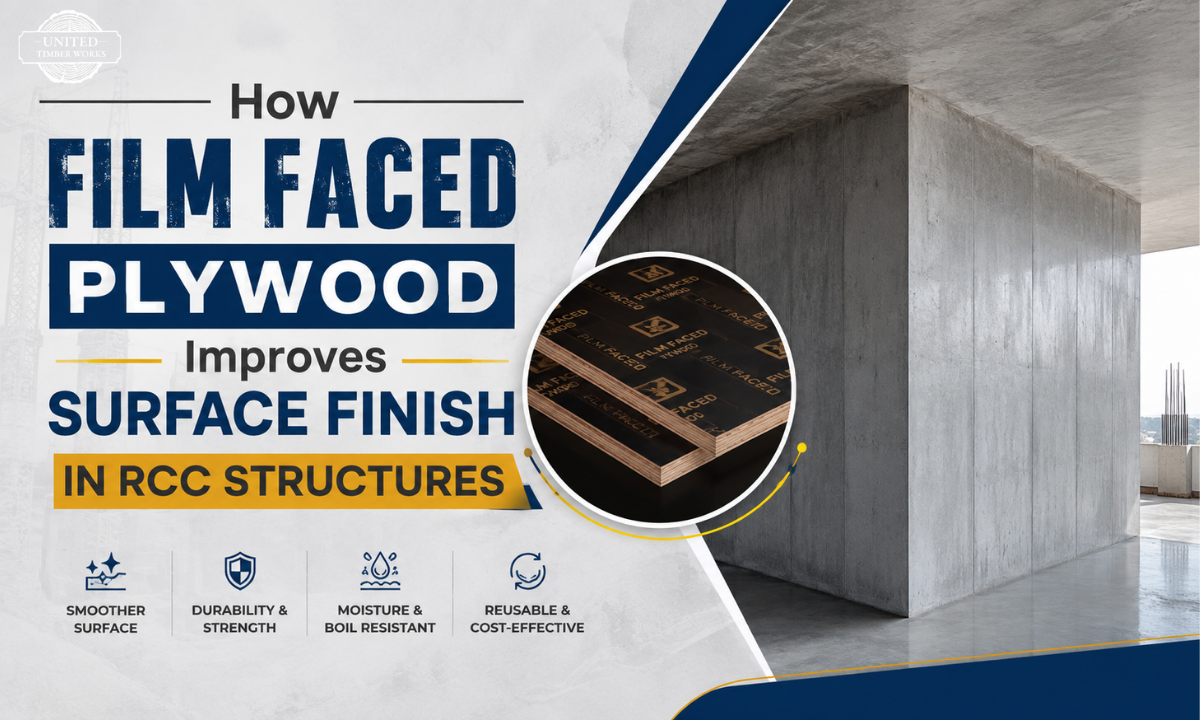
How Film Faced Plywood Improves Surface Finish in RCC Structures

Surface finish on an RCC structure is decided the moment concrete touches the formwork, not after. That’s why shuttering film faced plywood has quietly become one of the most important line items on a construction site’s material list, even though it rarely gets discussed the way cement grade or steel quality does. A patchy, honeycombed wall means rework, delays, and cost overruns. A smooth, uniform surface means the project keeps moving. That difference usually comes down to this component that rarely gets the credit it deserves. 

United Timber Works has been manufacturing it since 1977, and this blog walks through exactly why it makes such a visible difference to the finished surface. In this blog, we break down why film faced shuttering ply plays such a central role in RCC surface finish, and what actually happens at the material level to make that possible.

Why Surface Finish Quality Cannot Be an Afterthought

RCC, or Reinforced Cement Concrete, work depends heavily on the mould that shapes it. Contractors and site engineers often plan structural design, steel placement, and concrete mix in detail, yet the formwork material sometimes gets treated as a routine purchase decision. That approach creates problems later. A poor surface finish is rarely just a cosmetic issue. It usually points to underlying trouble such as:

  • Uneven concrete compaction against the shutter
  • Moisture seeping into the plywood and weakening its structure
  • Surface abrasion that transfers grain marks or roughness onto the concrete
  • Repeated deformation of panels after just a few uses

Each of these problems adds labour hours for plastering, patching, and finishing work that could have been avoided with the right formwork material from the start.

What Sets Film Faced Plywood Apart From Ordinary Shuttering Material

Regular plywood was never designed to handle the pressure, moisture, and repeated reuse that concrete formwork demands. Film faced shuttering ply addresses this by adding a resin-impregnated film layer on both faces of the board. The right manufacturer will make the plywood from selected hardwood veneers, bonded with phenolic resin and pressed for density. This construction gives the panel three qualities that directly influence how the final concrete surface turns out. Here they are:

1. A Smooth, Sealed Working Surface

The film coating creates a sealed, low-friction face that concrete does not stick to easily. When the formwork comes off, the surface strips clean instead of pulling away chunks of cement paste or leaving rough patches behind.

2. Resistance to Water Absorption

Concrete is wet by nature, and shuttering panels sit in direct contact with that moisture for hours during curing. Ordinary plywood absorbs this moisture, swells, and warps. A high-density waterproof shuttering film faced plywood resists that absorption, which keeps the panel flat and dimensionally stable through the pour.

3. Structural Density That Withstands Pressure

Fresh concrete exerts real lateral pressure on formwork, especially in columns, walls, and deep beams. A dense, well-bonded plywood sheet resists bending or bulging under that load. When the panel does not flex, the concrete face it produces stays flat and even.

How This Translates Into a Better RCC Finish

When a shuttering panel strips clean, stays flat under pressure, and resists moisture damage, the impact on the finished RCC surface is direct. These are the benefits you will notice: 

  • Fewer honeycombs and air pockets, since the sealed surface does not trap concrete unevenly
  • Reduced surface blemishes, because there is no rough grain transferring onto the cast face
  • More consistent panel-to-panel finish across large pours, which matters on bigger structures where uniformity is judged visually
  • Less dependency on plastering and surface correction after de-shuttering

For site teams working against tight schedules, this reduction in rework is not a minor benefit. It changes how quickly a project can move from one pour to the next.

Reusability Changes the Economics of a Project

A shuttering panel is rarely used just once. On most sites, the same set of panels goes through multiple cycles across different pours. This is where the quality of the film coating and the density of the core becomes a financial factor, not just a technical one.

Panels that degrade after two or three uses need frequent replacement, and every replacement adds cost and disrupts the work schedule. A well-manufactured shuttering  film faced plywood panel is built to go back up again on the next pour, holding its surface quality across repeated cycles instead of showing wear after the first few uses.

Where United Timber Works Fits Into This

This is exactly the gap the company has worked to close for construction teams across India. Our manufacturing runs out of an 8.5-acre integrated facility, and our shuttering plywood conforms to IS:4990 standards, built from premium Eucalyptus hardwood for strength and precision.

We currently offer five distinct film faced shuttering plywood options: UTW, Majestic, Express, Continental, and Everline. Each one is built around the same mirror finish philosophy, but the right choice for your site depends on factors specific to your project, such as the scale of the pour, the number of reuse cycles you are planning for, and the finish standard your client expects. Our team can walk you through which option fits your requirements rather than leaving you to guess.

Our track record backs this approach. We have delivered close to 14.47 crore square feet of shuttering plywood to more than 87 contractors and 169 dealers across India in the last five years, supported by a dealer network spread across 14 states, 46 cities, and 60 pincodes.

Get in Touch Before Your Next Site Order

Surface finish in RCC structures is not decided at the plastering stage, it is decided the moment concrete touches the formwork. Choosing shuttering film faced plywood that strips clean, resists moisture, and holds its shape under pressure saves both time and money across the life of a project.

If your site is looking for a shuttering partner that understands this, United Timber Works is ready to help. With over four decades of manufacturing experience, ISI-certified quality, and a dealer network built for reliable supply across India, we bring more than plywood to your project, we bring the consistency your RCC work needs. Reach out to our team today to find the right film faced shuttering plywood option for your next pour.

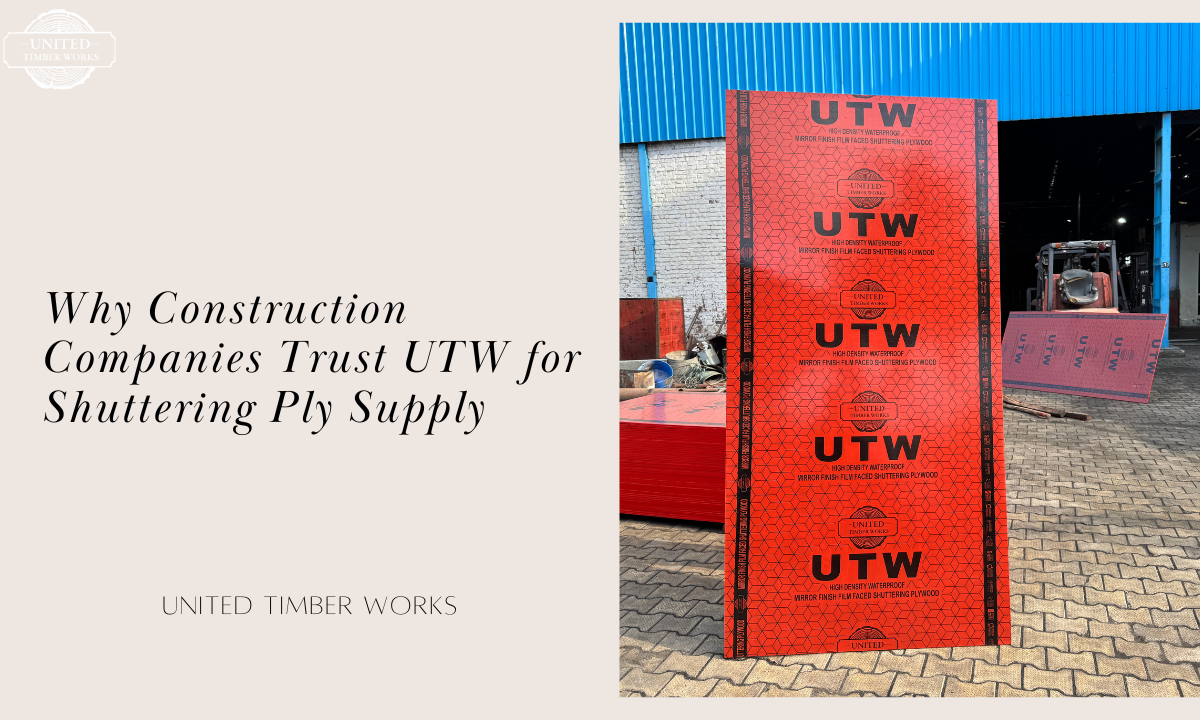
Why Construction Companies Trust UTW for Shuttering Ply Supply 

On paper, shuttering ply is just another line item. On-site, it decides whether your slab cycle holds or slips. Nobody praises a sheet that performs. But let one delaminate halfway through a pour, and suddenly it is all anyone near the mixer is talking about. The damage rarely stops at that one panel either. Rework, extra labour hours, a casting pushed back by days, and a delay that quietly works its way up the entire project timeline.

Contractors who have been burned once quickly learn that the vendor matters as much as the material. That lesson is why so many builders, developers, and contractors across India keep coming back to United Timber Works. We are a plywood manufacturer that has been in this business since 1977. What follows is a plain look at what that trust actually rests on, so you can weigh it against what your own sites demand.

The Real Cost of a Weak Shuttering Ply Manufacturer

Before looking at what the manufacturer does right, it helps to name what usually goes wrong. If you have handled material procurement for even one mid-sized project, some of these will sound familiar:

  • Substandard sheets that push up rejection rates on-site
  • Hours spent chasing drivers and coordinators just to know where your material is
  • Complaints that get acknowledged politely and then never resolved
  • Vendors who simply do not have the capacity when a large, time-bound order lands

None of these problems shows up in a quotation. They show up three weeks into the project, when switching suppliers is no longer practical. So the smarter approach is to evaluate the manufacturer before the first order, not after the first failure.

What Sets UTW Apart as a Shuttering Ply Manufacturer

A shuttering ply manufacturer earns repeat orders on three things. The factors are the board itself, the ability to deliver it on time, and what happens when something goes wrong. The company has built its reputation on these factors:

It Starts with the Raw Material

UTW produces high-density waterproof film-faced shuttering plywood made from premium Eucalyptus hardwood, conforming to IS:4990 standards. That certification matters more than most brochures admit. IS:4990 is the Indian standard specifically written for plywood used in concrete shuttering work, and boards that conform to it are built to handle the moisture, pressure, and handling stress of real concrete pours, not just laboratory conditions.

For a contractor, this translates into fewer surprises. The film face releases cleanly from cured concrete, the mirror finish reduces the effort on the finishing side, and the sheets behave predictably from batch to batch.

Five Brands, One Manufacturing Discipline

Different projects have different budgets and requirements, and the manufacturer addresses this through five waterproof shuttering brands: UTW, Majestic, Express, Continental, and Everline. Every one of them comes out of the same plant, through the same processes and the same quality checks.

This is worth pausing on. When one factory discipline stands behind every option, you are not gambling on quality when you pick the brand that fits your budget. The variation is in the product tier, not in the seriousness of the manufacturing behind it.

A Supply Network That Actually Reaches Your Site

Good plywood sitting in a factory does not pour concrete. United Timber Works backs its manufacturing with an active dealer network spread across states, cities, and pin codes throughout India. For a construction company running projects in multiple locations, that reach means the material source stays consistent even when the site address changes.

Dealers are not left to manage stock on guesswork either. The company backs them with CRM tools built to maximise inventory turnover, a level of hand-holding few manufacturers in this segment bother with. For the contractor at the end of the chain, that means the sheets you need are far more likely to be in stock the day you need them.

Support That Does Not Disappear After Dispatch

Here is where most suppliers quietly fall short. The sale ends, the truck leaves, and the relationship goes cold until the next purchase order. The company has structured its after-sales differently, with dedicated CRM support, timely follow-ups that prevent stockouts, and a 30-minute issue response commitment.

The result shows up in one particularly telling figure: a complaint rate of just 0.21 per cent, the lowest in the industry. When a manufacturer moves crores of square feet of material and complaints stay that low, it is not luck. It is a process.

The Track Record, in Plain Terms

For readers who prefer proof over prose, here is what UTW’s operations look like at a glance:

  • 47+ years of plywood manufacturing legacy
  • 8.5-acre integrated manufacturing facility in Yamuna Nagar, Haryana
  • Around 14.47 crore sq ft of shuttering plywood has been delivered to 87+ contractors and 169 dealers across India in the last 5 years
  • 70+ active dealers across 14 states, 46 cities, and 60 pincodes
  • 80% on-time delivery achieved across projects

These are not aspirational targets. They are operating numbers, and they explain why our clientele ranges from infrastructure megaprojects to premium residential and commercial developments.

Build Your Next Project with United Timber Works

Trust in construction supply is never won through advertising. It is won pour by pour, delivery by delivery, until reliability becomes a habit the client can plan around. That is the reputation United Timber Works has built, and the numbers above show what it looks like in practice. If your current vendor is holding your project back, or if you are simply comparing options before the next big order, talk to our team. Whether you need certified shuttering ply for an upcoming project or want to explore becoming a dealer in India’s fastest-growing plywood network, the process starts with a single conversation.

Call +91 96714 89888, write to info@unitedtimberworks.com, or visit unitedtimberworks.com to request a quote today. Your project deserves more than just plywood. It deserves a partner invested in your success.